
Main Page
Featured Topic
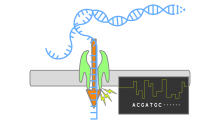
Nanopores are nanoscale openings that allow ions or molecules to pass through a membrane or solid-state material. When a molecule moves through or near a nanopore, it can change an electrical current, ion flow, or another measurable signal. These signal changes can be used to study DNA, RNA, proteins, small molecules, and other biological or chemical systems at single-molecule scale.
Did You Know?
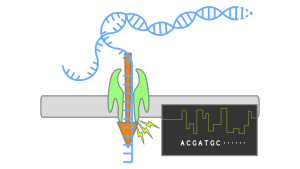
- Nanopore sequencing reads molecular signals directly as DNA or RNA passes through a nanoscale pore.
- Long reads can help resolve repeats, structural variants, and complex genome regions.
- Some nanopore methods can detect RNA or base modifications without converting molecules into short amplified fragments.
- Portable instruments make sequencing possible in field, classroom, clinical, and small-laboratory settings.
Picture of the Day
News and Research Updates
- 2026-06-27 - Nanopore Wiki homepage launched with a portal-style layout for tracking nanopore technology, sequencing, tools, and research progress.
Start Here
- Nanopore technology - principles, pore types, signals, and measurement concepts.
- Nanopore sequencing - how DNA and RNA sequencing with nanopores works.
- Single-molecule detection - how nanopores can detect individual molecules.
- Bioinformatics - basecalling, read mapping, assembly, variants, and quality control.
- Glossary - concise definitions of common terms.
Nanopore Wiki Reminds You
Nanopore Wiki is an educational and knowledge-organization project. Its pages are intended for science communication and general technical reference, and do not replace professional medical, legal, regulatory, or commercial advice. Claims about breakthroughs, clinical use, or product performance should be supported by reliable sources.
Knowledge Areas |
Methods |
Community |
Nanopore Wiki is a knowledge and science-outreach project. The site can reserve space for related multilingual, open-content tasks and community-maintained resources:
| G | Glossary Concise definitions for nanopore terms. | N | News and papers Research updates, high-level papers, and technology progress. |
| D | Data and bioinformatics Workflows for signal, reads, mapping, assembly, and variants. | I | Instruments and workflows Portable sequencing devices and practical methods. |
| H | Help How to read, search, and contribute. | E | Editorial guidelines Quality standards for rigorous writing and sourcing. |
