
Main Page/de: Difference between revisions
Updating to match new version of source page |
Updating to match new version of source page |
||
| Line 1: | Line 1: | ||
__NOTOC__ | __NOTOC__ | ||
<div class="mw-translate-fuzzy"> | |||
<div style="border:1px solid #a2a9b1; background:#f8f9fa; padding:1.2em; margin-bottom:1em; overflow:hidden;"> | <div style="border:1px solid #a2a9b1; background:#f8f9fa; padding:1.2em; margin-bottom:1em; overflow:hidden;"> | ||
[[File:Nanopore_sequencing_principle.png|thumb|right|360px|link=https://www.nanopore.net/index.php?curid=2|Principle of nanopore sequencing. Source: Wikimedia Commons, DBCLS, CC BY 4.0.]] | [[File:Nanopore_sequencing_principle.png|thumb|right|360px|link=https://www.nanopore.net/index.php?curid=2|Principle of nanopore sequencing. Source: Wikimedia Commons, DBCLS, CC BY 4.0.]] | ||
<div style="font-size:188%; line-height:1.2; margin-bottom:0.25em;">Willkommen bei Nanopore Wiki</div> | <div style="font-size:188%; line-height:1.2; margin-bottom:0.25em;">Willkommen bei Nanopore Wiki</div> | ||
<div style="font-size:108%; max-width:58em;">Eine Wissensdatenbank und ein Wissenschaftsausstiegssite für Nanopore-Technologie, Nanopore-Sequenzierung, Single-Molecule-Sensing, Bioinformatik-Workflows, Instrumente und Grenzgebietsforschung.</div> | <div style="font-size:108%; max-width:58em;">Eine Wissensdatenbank und ein Wissenschaftsausstiegssite für Nanopore-Technologie, Nanopore-Sequenzierung, Single-Molecule-Sensing, Bioinformatik-Workflows, Instrumente und Grenzgebietsforschung.</div> | ||
</div> | |||
</div> | </div> | ||
| Line 85: | Line 87: | ||
<div lang="en" dir="ltr" class="mw-content-ltr"> | <div lang="en" dir="ltr" class="mw-content-ltr"> | ||
<div class="np-projects"><div class="np-project-intro"><b>Nanopore Wiki</b> is a knowledge and science-outreach project. The site can host related multilingual, open-content tasks and community-maintained resources:</div> | |||
</div> | </div> | ||
<div lang="en" dir="ltr" class="mw-content-ltr"> | <div lang="en" dir="ltr" class="mw-content-ltr"> | ||
<div | <div class="np-project-grid"> | ||
<div class="np-project-item"><div class="np-project-icon">G</div><div><div class="np-project-title">[[Glossary|Glossary]]</div><div class="np-project-desc">Concise definitions for nanopore terms.</div></div></div> | |||
</div> | <div class="np-project-item"><div class="np-project-icon">N</div><div><div class="np-project-title">[[Latest Progress|News and papers]]</div><div class="np-project-desc">Research updates, high-level papers, and technology progress.</div></div></div> | ||
< | <div class="np-project-item"><div class="np-project-icon">D</div><div><div class="np-project-title">[[Bioinformatics|Data and bioinformatics]]</div><div class="np-project-desc">Workflows for signal, reads, mapping, assembly, and variants.</div></div></div> | ||
<div class="np-project-item"><div class="np-project-icon">I</div><div><div class="np-project-title">[[MinION|Instruments and workflows]]</div><div class="np-project-desc">Portable sequencing devices and practical methods.</div></div></div> | |||
<div | <div class="np-project-item"><div class="np-project-icon">H</div><div><div class="np-project-title">[[Help:Contents|Help]]</div><div class="np-project-desc">How to read, search, and contribute.</div></div></div> | ||
<div class="np-project-item"><div class="np-project-icon">E</div><div><div class="np-project-title">[[Nanopore Wiki:Editorial guidelines|Editorial guidelines]]</div><div class="np-project-desc">Quality standards for rigorous writing and sourcing.</div></div></div> | |||
</div></div> | |||
</div> | </div> | ||
| Line 113: | Line 106: | ||
* [https://en.wikipedia.org/wiki/Nanopore_sequencing Nanopore sequencing - Wikipedia] | * [https://en.wikipedia.org/wiki/Nanopore_sequencing Nanopore sequencing - Wikipedia] | ||
* [https://commons.wikimedia.org/wiki/File:202001_nanopore_sequencing.svg Principle of nanopore sequencing - Wikimedia Commons] | * [https://commons.wikimedia.org/wiki/File:202001_nanopore_sequencing.svg Principle of nanopore sequencing - Wikimedia Commons] | ||
</div> | |||
</div> | </div> | ||
<languages /> | <languages /> | ||
Revision as of 13:40, 29 June 2026
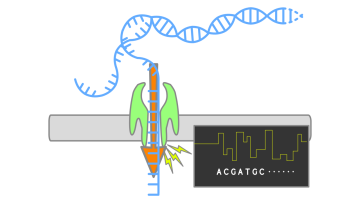
Nanoporen sind nanoskalige Öffnungen, die es Ionen oder Molekülen ermöglichen, durch eine Membran oder ein feststoffbasiertes Material zu passieren. Wenn ein Molekül durch oder in der Nähe eines Nanoporen bewegt wird, kann es einen elektrischen Strom, Ionenfluss oder ein anderes messbares Signal verändern. Diese Signaländerungen können verwendet werden, um DNA, RNA, Proteine, kleine Moleküle und andere biologische oder chemische Systeme auf der Einzelmolekülebene zu untersuchen.
Nanopore-Methoden sind wichtig, weil sie molekulare Ereignisse mit Echtzeitmessungen verbinden können. Beim Sequenzieren passieren lange DNS- oder RNA-Moleküle ein Pore und erzeugen Signale, die in Sequenzinformation umgewandelt werden können. Beim Sensieren können Änderungen des Stroms oder anderer Signale die molekulare Größe, Ladung, Struktur, Bindung oder chemische Modifikation offenbaren.
Hier anfangen
|
Warum es wichtig ist
|
Anwendungen
|
Werkzeuge und Workflows
|
Neueste Fortschritte
|
BeitragenNanopore Wiki begrüßt sorgfältige Beiträge: klare Definitionen, verlässliche Quellen, nachvollziehbare Methoden und ausgewogene Zusammenfassungen aktueller Forschung. Neue Fortschrittsmeldungen sollten ein Datum, eine prägnante Erklärung und eine Quelle, soweit verfügbar, enthalten. == Site Notes (Note: The term "Site Notes" is often used in English for specific sections or pages. If there is a more common German term or phrase used in the context of MediaWiki, please provide it for a more accurate translation.) Seitennotizen == Nanopore Wiki ist ein bildungs- und wissensorganisatorisches Projekt. Seine Seiten dienen der Wissenschaftskommunikation und allgemeinen technischen Referenz und ersetzen keinen professionellen medizinischen, rechtlichen, regulatorischen oder kommerziellen Rat. |
