
Main Page/en: Difference between revisions
Updating to match new version of source page |
Updating to match new version of source page |
||
| Line 1: | Line 1: | ||
__NOTOC__ | __NOTOC__ | ||
<div style="border:1px solid #a2a9b1; background:#f8f9fa; padding:1.2em; margin-bottom:1em; overflow:hidden;"> | <div style="border:1px solid #a2a9b1; background:#f8f9fa; padding:1.2em; margin-bottom:1em; overflow:hidden;"> | ||
[[File:Nanopore_sequencing_principle.png|thumb|right|360px|Principle of nanopore sequencing. Source: Wikimedia Commons, DBCLS, CC BY 4.0.]] | [[File:Nanopore_sequencing_principle.png|thumb|right|360px|link=https://www.nanopore.net/index.php?curid=2|Principle of nanopore sequencing. Source: Wikimedia Commons, DBCLS, CC BY 4.0.]] | ||
<div style="font-size:188%; line-height:1.2; margin-bottom:0.25em;">Welcome to Nanopore Wiki</div> | <div style="font-size:188%; line-height:1.2; margin-bottom:0.25em;">Welcome to Nanopore Wiki</div> | ||
<div style="font-size:108%; max-width:58em;">A knowledge base and science outreach site for nanopore technology, nanopore sequencing, single-molecule sensing, bioinformatics workflows, instruments, and frontier research.</div> | <div style="font-size:108%; max-width:58em;">A knowledge base and science outreach site for nanopore technology, nanopore sequencing, single-molecule sensing, bioinformatics workflows, instruments, and frontier research.</div> | ||
</div> | </div> | ||
Nanopores are nanoscale openings that allow ions or molecules to pass through a membrane or solid-state material. When a molecule moves through or near a nanopore, it can change an electrical current, ion flow, or another measurable signal. These signal changes can be used to study DNA, RNA, proteins, small molecules, and other biological or chemical systems at single-molecule scale. | |||
Nanopore methods matter because they can connect molecular events with real-time measurements. In sequencing, long DNA or RNA molecules pass through a pore and generate signals that can be converted into sequence information. In sensing, changes in current or other signals can reveal molecular size, charge, structure, binding, or chemical modification. | |||
{| style="width:100%; border-spacing:10px; border-collapse:separate;" | {| style="width:100%; border-spacing:10px; border-collapse:separate;" | ||
| style="width:50%; vertical-align:top; border:1px solid #a2a9b1; background:#f8f9fa; padding:1em;" | | | style="width:50%; vertical-align:top; border:1px solid #a2a9b1; background:#f8f9fa; padding:1em;" | | ||
== Start Here == | == Start Here == | ||
* [[Nanopore technology]] | * [[Nanopore technology]] - principles, pore types, signals, and measurement concepts. | ||
* [[Nanopore sequencing]] | * [[Nanopore sequencing]] - how DNA and RNA sequencing with nanopores works. | ||
* [[Single-molecule detection]] | * [[Single-molecule detection]] - how nanopores can detect individual molecules. | ||
* [[Bioinformatics]] | * [[Bioinformatics]] - basecalling, read mapping, assembly, variants, and quality control. | ||
* [[Glossary]] | * [[Glossary]] - concise definitions of common terms. | ||
| style="width:50%; vertical-align:top; border:1px solid #a2a9b1; background:#f8f9fa; padding:1em;" | | |||
== Why It Matters == | |||
* Long reads can span repeats, structural variants, and complex genomic regions. | |||
* Real-time analysis can support rapid decisions in field, clinical, and laboratory settings. | |||
* Portable instruments make sequencing and sensing possible outside large sequencing centers. | |||
* Direct molecular measurements can preserve information about RNA, base modifications, or molecular context. | |||
|- | |- | ||
| style="width:50%; vertical-align:top; border:1px solid #a2a9b1; background:#f8f9fa; padding:1em;" | | | style="width:50%; vertical-align:top; border:1px solid #a2a9b1; background:#f8f9fa; padding:1em;" | | ||
== | == Applications == | ||
* | * Public health surveillance and pathogen genomics | ||
* | * Clinical and infectious disease research | ||
* | * Environmental DNA and biodiversity monitoring | ||
* | * Microbiome and metagenomic analysis | ||
* | * Agriculture, food safety, and biosecurity | ||
* | * Structural variation, genome assembly, RNA analysis, and epigenetic modification detection | ||
| style="width:50%; vertical-align:top; border:1px solid #a2a9b1; background:#f8f9fa; padding:1em;" | | | style="width:50%; vertical-align:top; border:1px solid #a2a9b1; background:#f8f9fa; padding:1em;" | | ||
== Tools and Workflows == | == Tools and Workflows == | ||
* [[MinION]] | * [[MinION]] and other portable sequencing instruments | ||
* [[Oxford Nanopore]] | * [[Oxford Nanopore]] platforms and chemistry concepts | ||
* | * Basecalling from raw signal to sequence reads | ||
* | * Read mapping, variant calling, genome assembly, and quality control | ||
* Experimental design, metadata, reproducibility, and responsible interpretation | |||
* | |||
|- | |- | ||
| style="width:50%; vertical-align:top; border:1px solid #a2a9b1; background:#f8f9fa; padding:1em;" | | | style="width:50%; vertical-align:top; border:1px solid #a2a9b1; background:#f8f9fa; padding:1em;" | | ||
== | == Latest Progress == | ||
{{:Latest Progress}} | |||
| style="width:50%; vertical-align:top; border:1px solid #a2a9b1; background:#f8f9fa; padding:1em;" | | | style="width:50%; vertical-align:top; border:1px solid #a2a9b1; background:#f8f9fa; padding:1em;" | | ||
== Contribute == | == Contribute == | ||
Nanopore Wiki welcomes careful contributions: clear definitions, reliable sources, reproducible methods, and balanced summaries of recent research. New progress items should include a date, a concise explanation, and a source when available. | |||
== Site Notes == | |||
Nanopore Wiki is an educational and knowledge-organization project. Its pages are intended for science communication and general technical reference, and do not replace professional medical, legal, regulatory, or commercial advice. | |||
== References == | == References == | ||
Revision as of 13:01, 29 June 2026
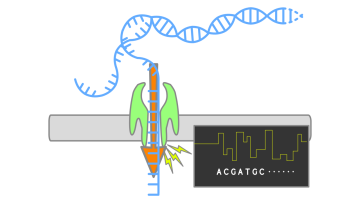
Nanopores are nanoscale openings that allow ions or molecules to pass through a membrane or solid-state material. When a molecule moves through or near a nanopore, it can change an electrical current, ion flow, or another measurable signal. These signal changes can be used to study DNA, RNA, proteins, small molecules, and other biological or chemical systems at single-molecule scale.
Nanopore methods matter because they can connect molecular events with real-time measurements. In sequencing, long DNA or RNA molecules pass through a pore and generate signals that can be converted into sequence information. In sensing, changes in current or other signals can reveal molecular size, charge, structure, binding, or chemical modification.
Start Here
|
Why It Matters
|
Applications
|
Tools and Workflows
|
Latest Progress
|
ContributeNanopore Wiki welcomes careful contributions: clear definitions, reliable sources, reproducible methods, and balanced summaries of recent research. New progress items should include a date, a concise explanation, and a source when available. Site NotesNanopore Wiki is an educational and knowledge-organization project. Its pages are intended for science communication and general technical reference, and do not replace professional medical, legal, regulatory, or commercial advice. References |
